
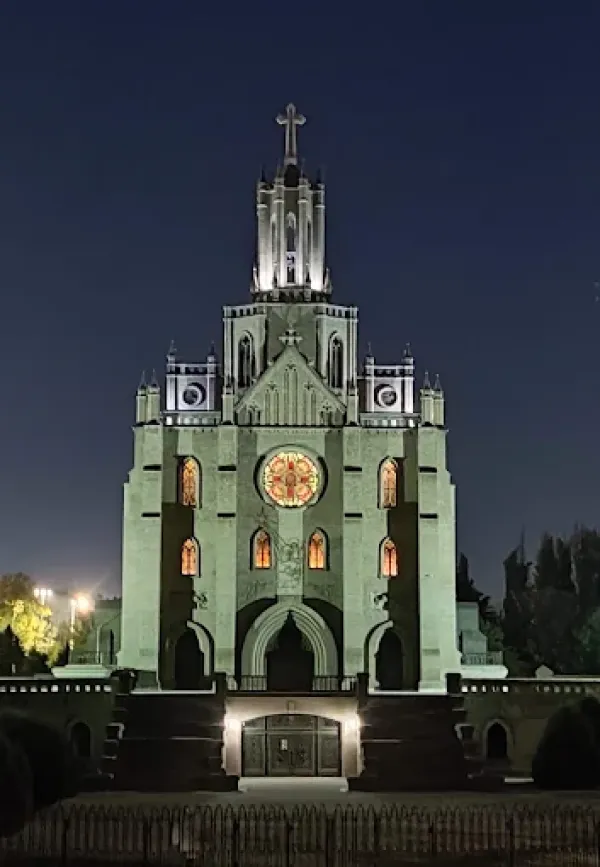
Roman Catholic Church of the Sacred Heart of Jesus
Christianity penetrated into the territory of Central Asia in the first centuries of our era due to the development of the Great Silk Road. Along with the trading caravans, refugees, travelers and missionaries followed one of the most famous ancient routes, preaching their religion in foreign lands.
However, the first Catholic metropolitans and dioceses along the Silk Road appeared much later - in the 12th-10th centuries, when diplomatic relations between the Vatican and China were established.
The active spread of Catholicism in the countries of the Central Asian region began in the second half of the 19th and early 20th centuries and was associated with the Russian expansion in the East. According to statistics, by 1917, 11 thousand Catholics lived in Turkestan, 7 thousand of whom lived in Tashkent. These were Poles, Lithuanians, Germans, French, and Latvians from among the soldiers of the tsarist army, whom the government sent to serve far from their homeland: to the Far East, Turkestan, and the Caucasus. There were also many exiles, Western European prisoners of war, and refugees in Turkestan.
From 1883 to 1885, Fr. Ferdinand Senchikovsky was the first official Catholic priest in the Turkestan region. Thanks to his efforts, a Catholic chapel was built in Tashkent, where masses were held.
From 1902 to 1917, the curator of the Turkestan region was Fr. Justin Bonaventura Pranaitis. During this period, churches were built in Ashgabat, Kyzyl-Arvat (Turkmenistan), Ferghana, Samarkand, and a temporary chapel church in Tashkent. In 1912, the construction of a large Tashkent Catholic church began near the Catholic chapel. Catholic soldiers participated in the construction of that temple, among whom there were many qualified specialists.
Construction proceeded slowly, and in 1917 the revolution began, after which the successor of Pranaitis, fr. Boleslav Rutenis, tried to complete the Tashkent church. But he never succeeded due to the changing political situation in the country, pressure from the Bolsheviks and lack of funds. Soon, unable to stand it, Ruthenis resigned from his post as abbot. After Ruthenis voluntarily resigned from his post, Fr. Joseph Sovinsky. In 1937, he was arrested on charges of anti-Soviet propaganda and shot.
And what happened to the unfinished temple? In 1925, the church was nationalized. During the Soviet period, it housed various organizations: dormitories for an electric cable factory and a Republican obstetric school, a medical equipment office and warehouse. The building was rebuilt many times, and finally was abandoned. Naturally, by that time, neither the sculptures nor the valuables from the temple had been preserved.
In 1976, thanks to the decree of the authorities, the building was restored and given to the Ministry of Culture of the Uzbek SSR, and in 1981 it was declared an architectural and historical monument of Uzbekistan.
The official activity of Catholic organizations in Uzbekistan resumed only in 1987. First, a Catholic parish was reopened in Ferghana, and 3 years later, a Catholic church was opened in Tashkent, led by Fr. Krzysztof Kukulka, a Polish Franciscan appointed by Pope John Paul II in 1997 as ordinariate of the Missio sui Juris in Uzbekistan.
Since 1992, with the independence of Uzbekistan, the temple was returned to the Catholic parish of Tashkent. And in January 1993, its restoration began, which was led by architect Sergey Adamov and designer Alexander Ponomarev, and Kukulka took over the organizational matters.
Then, during the construction, the construction of the old Catholic chapel, which was located in the house of the Polish society at the construction site, was included in the plan of the new church. The construction of the Catholic church under the proclamation of the Sacred Heart of Jesus was completed in 2000, 88 years after the laying of its first stone.
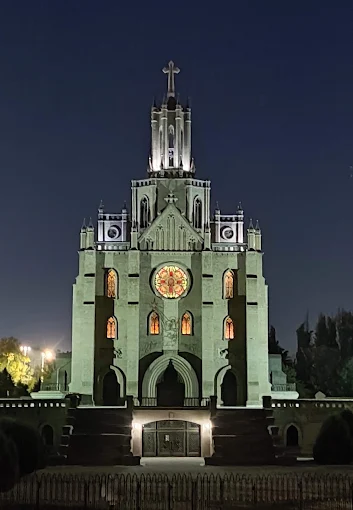
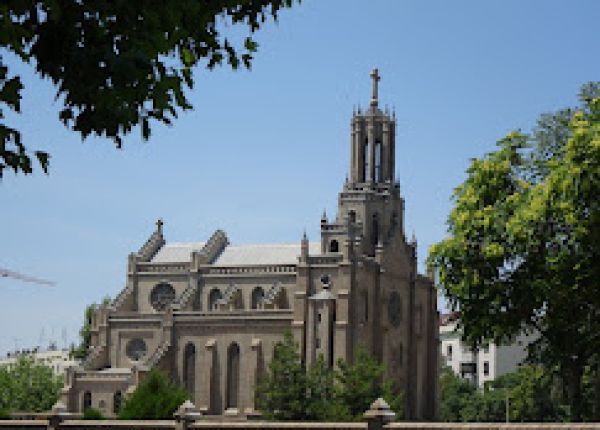
The temple was immediately recognized as one of the most beautiful and unusual architectural structures of modern Tashkent for the East.
I must say that the architecture, decor and interior of the temple are impressive. The temple is built in the Gothic style, the building is lined with marble and granite, and the doors and furniture are made of precious woods. Candlesticks, candelabra, artistic fence and railings, etc. were made by the blacksmith V. Pilipyuk.
On the ground floor of the temple are the rooms of the crypt chapel (the one built under fr. Pranaitis at the beginning of the 20th century), John Paul II Hall and St. Peter's Hall. Antonia.
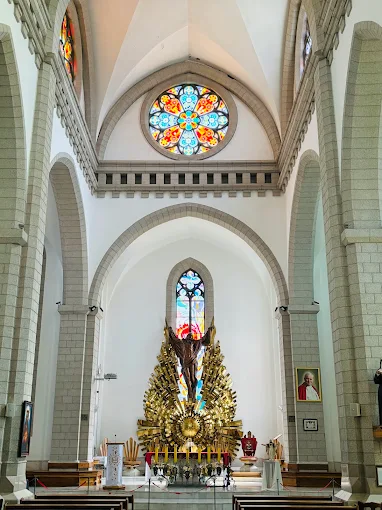
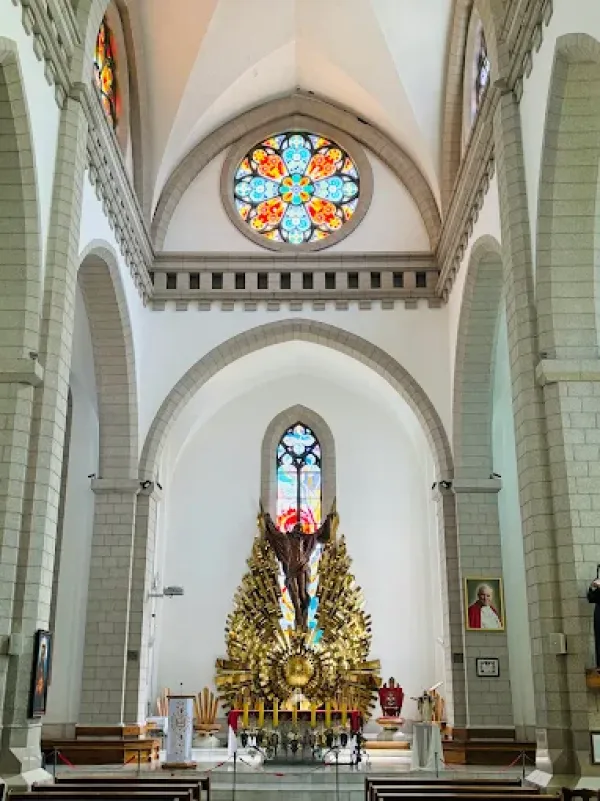
On the second floor there is a solemn main hall, where Sunday Masses are held. An altar with a tabernacle decorated with a 2-meter sculpture of Christ occupies a place of honor in the hall.
Rows of massive wooden benches for parishioners are placed between the huge columns. A 26-voice organ, a gift from St. Paul's Bonn parish, is installed in front of the altar under the arches of the church. The hall is decorated with images of scenes from the Bible, stained glass windows, and Catholic symbols. To the right of the altar is the confessional, where Catholics perform the sacrament of penance.
Masses in the Tashkent Catholic Church are held daily in four languages: Russian, English, Polish and Korean.
In the early 90s of the last century, along with the construction of the temple in Tashkent, Catholic parishes were opened in other major cities of Uzbekistan: Samarkand, Bukhara and Urgench. The growth of the Catholic flock in Uzbekistan and the efforts of Tashkent Catholic ministers did not go unnoticed in the Vatican, and in 2005 Pope John Paul II elevated the status of Missio sui Juris in the Republic of Uzbekistan to the title of Apostolic Administration and appointed Fr. Jerzy Matsulevich was the first bishop in Uzbekistan. Currently, the rector of the Tashkent temple is Fr. Lucian Shimansky. Catholic priests and monastic Franciscan brothers, as well as missionaries of the Order of Divine Love (Sisters of Mother Teresa), are constantly in Uzbekistan.




Place on the map
Tours where you can visit this place:
Roman Catholic Church of the Sacred Heart of Jesus
Tashkent — Bukhara — Samarkand — Shakhrisabz
- 720$
- 7d.

Roman Catholic Church of the Sacred Heart of Jesus
Tashkent — Bukhara — Samarkand
- 640$
- 7d.

Roman Catholic Church of the Sacred Heart of Jesus
Tashkent — Bukhara — Samarkand — Khiva — Khorezm
- 730$
- 7d.
Roman Catholic Church of the Sacred Heart of Jesus
Tashkent — Bukhara — Samarkand
- 500$
- 5d.

Roman Catholic Church of the Sacred Heart of Jesus
Tashkent — Bukhara — Samarkand — Khiva
- 590$
- 6d.
Roman Catholic Church of the Sacred Heart of Jesus
Tashkent — Bukhara — Samarkand — Shakhrisabz
- 1150$
- 7d.

Roman Catholic Church of the Sacred Heart of Jesus
Tashkent — Bukhara — Samarkand — Khiva — Shakhrisabz — Gizhduvan
- 1200$
- 10d.
Roman Catholic Church of the Sacred Heart of Jesus
Tashkent — Bukhara — Samarkand
- 675$
- 5d.
