


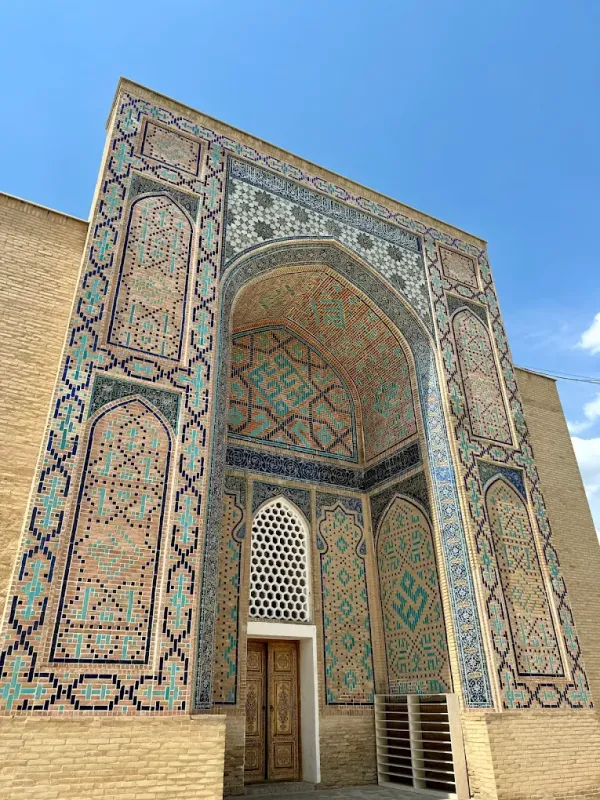


Shahi Zinda Necropolis
"And hiding the secret of eternity, like a distant star in the sky,
Standing there, mysteriously shimmering blue, is Shahi-Zinda"
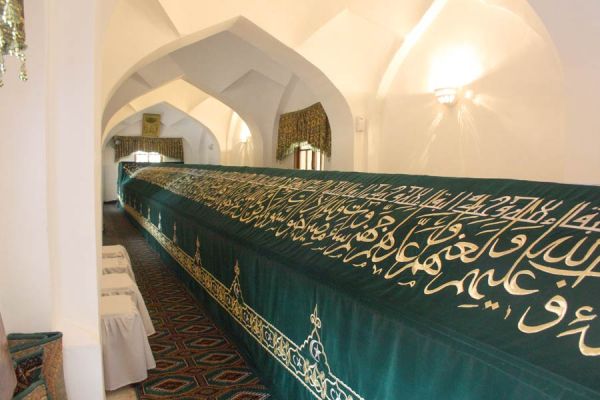
The Shahi Zinda necropolis is located in the northern part of the city of Samarkand on the hills of ancient Afrosiab. The historical core of this necropolis is the mausoleum of Qusam ibn Abbas. The cousin of the Prophet Muhammad, Kusam, according to the Arab chronicles, arrived in Samarkand in 676. Here he spread the religion of Islam and was killed by pagans while praying. But Kusam is popularly known as Shah-i-Zinda, “The Living King,” because, according to legend, he left this world alive.
His grave was deeply revered by Muslims in the following centuries. The flow of Muslim pilgrims to Shahi Zinda is still ongoing..
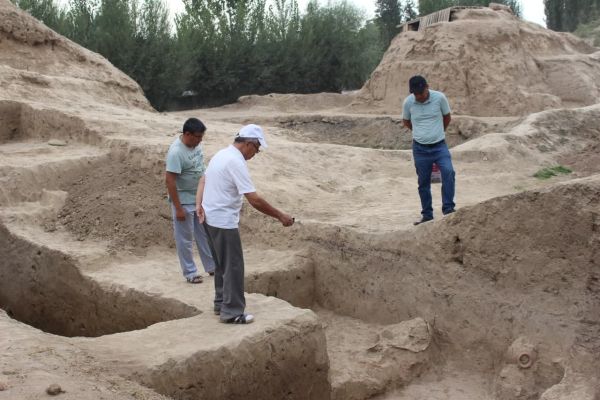
The oldest buildings of the ensemble, of which only the foundations and tombstones have been preserved, date back to the XI—XII centuries. The vast majority of buildings date back to the 14th—15th century, and the rebuilding of the 16th—19th centuries had virtually no effect on the composition and appearance of the complex.
Shahi Zinda is the only archaeological and architectural monument in Samarkand, which, including the cultural strata of Afrasiab, reflects the almost 25-century history of the city.
The Shahi-Zinda architectural ensemble is a unique museum of glazed decoration of the 14th-17th centuries. Here you can find both water-carved terracotta, and fine examples of set mosaics and large mosaics of irrigation bricks. In terms of subtlety, elegance and variety of forms, no architectural monument in Samarkand can compare with the mausoleums of Shahi Zinda.
The entrance portal of the complex is its newest construction. The interior buildings of the ensemble are divided into lower, middle and upper groups, with a staircase consisting of 40 steps leading up to them. All the buildings are interconnected by arched-domed passageways.
In the lower group of buildings on the terrace near the entrance there is a two-domed mausoleum. The middle group of buildings consists of a group of mausoleums dating back to Timur (14th — 15th centuries), where his relatives and prominent military and religious figures are buried.. Among them are the mausoleums of Emir Zade (1386), Tuglu-Tekin, Timur's nieces Shadi-Mulk-aka (Turkan-aka) (1371-1372) and Timur's sisters Shirin-bika-aka (1385-1386). In addition to the surviving mausoleums, the middle group also includes the remains of structures that have not survived to this day. Not far from the Shirin bika-aka mausoleum, noticeably different from other structures, there is an octagonal mausoleum of the first half of the XV century with openings open on the sides. It is decorated with a mosaic of glazed bricks and was probably originally covered by a dome on a high cylindrical drum.
The center of the whole ensemble is the Qusam ibn Abbas complex, which includes several buildings, among which the most ancient are the mausoleum of Qusam ibn Abbas and the mosque of the XVI century. A door with a date of 1404-1405, decorated with carvings and originally inlaid with ivory, leads to the complex.
The upper group of buildings includes three mausoleums facing each other, as if competing with the beauty of the cladding and forming a charming shaded courtyard. The northern part of the courtyard is enclosed by the mausoleum of Khoja Ahmad, built in the pre-Timur period around the 1340s. The eastern and western sides of this courtyard are surrounded by an unnamed mausoleum from 1360-1361 and the Tuman-aka mausoleum from the early 15th century.
A mysterious staircase consisting of 40 steps leads to the entrance to the Shahi Zinda complex. It is said that pilgrims visiting this place did not immediately ascend to the shrine, but established a 40-day prayer service for themselves, after which they reached the upper platform of the shrine. The pilgrim could climb only one step per day, while staying on it all day, he quietly whispered prayers from the Koran and reflected on his actions and intentions. And the mystery of the stairs is that if you count the steps when going up and down the stairs, no one has the same number of steps.
Don't you believe it? Do the math yourself.
In terms of elegance, sophistication of forms and variety of decorations, the Shahi-Zinda necropolis occupies a worthy place among other monuments of the East.



Place on the map
Tours where you can visit this place:
Shahi Zinda Necropolis
Tashkent — Bukhara — Samarkand — Shakhrisabz
- 720$
- 7d.

Shahi Zinda Necropolis
Tashkent — Bukhara — Samarkand
- 640$
- 7d.

Shahi Zinda Necropolis
Tashkent — Bukhara — Samarkand — Khiva — Khorezm
- 730$
- 7d.
Shahi Zinda Necropolis
Tashkent — Bukhara — Samarkand
- 500$
- 5d.

Shahi Zinda Necropolis
Bukhara — Samarkand — Shakhrisabz
- 480$
- 5d.

Shahi Zinda Necropolis
Bukhara — Samarkand — Khiva
- 440$
- 5d.
Shahi Zinda Necropolis
Tashkent — Bukhara — Samarkand — Khiva
- 590$
- 6d.
Shahi Zinda Necropolis
Tashkent — Bukhara — Samarkand — Shakhrisabz
- 1150$
- 7d.
