


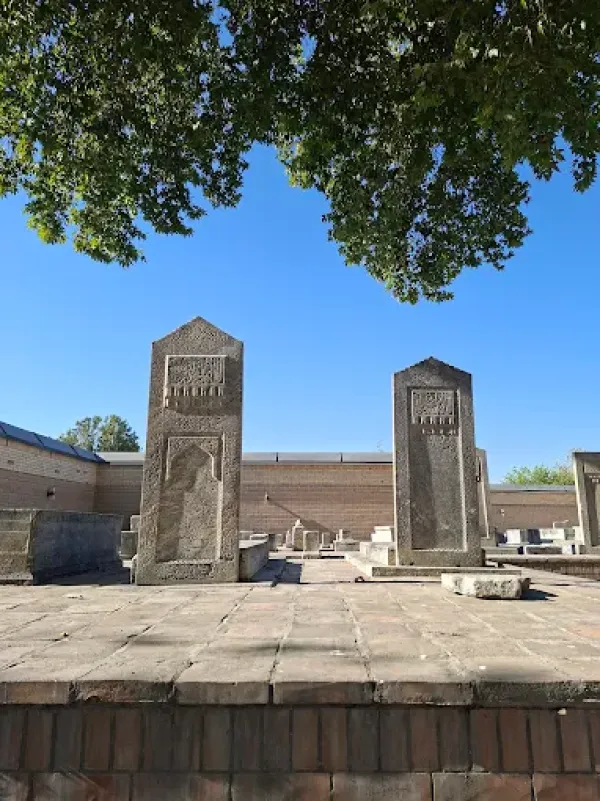


Juma Mosque Khoja Ahror Wali
In 1630-1635, Nodir Divanbegi was the chief vizier of the Bukhara Emir Imamkulikhan, a few kilometers south of Samarkand, next to the "dahma" (burial) Khoja Akhrora Vali, built a madrasah. The madrasah, which was named Nodir Divanbegi Madrasah, was built in honor of a prominent figure of the Naqshbandi Order, the famous Sheikh Khoja Ahror Wali. Khoja Ahrar, the head of the Naqshbandiya Sufi order ("Sufism" is a mystical trend in Islam), is a native of the mountainous village of Bogistan in the Tashkent region. Khoja Ahrar first visited Samarkand in 1426 at the age of 22, and finally moved to Samarkand in 1451, after the death of Ulugbek, during the reign of Abu Sayyid, one of the representatives of the Temurid dynasty. Under his pupil Tsarevich Ahmad, he achieved almost unlimited power and became the de facto ruler of Samarkand and the richest landowner in the state.
The great medieval poet Jami called him "Khoja Khoja", "A person who is aware of the essence of the subject." "Before his holiness, appearance, and strength of spirit, people prostrated themselves." His motto was: "To fully fulfill one's spiritual mission in the world, one must use political power." This motto defined all further social and political activities of the Naqshbandiya Order. One of Khoja Ahrar's titles was "Hazrat-i Imam" (holy Imam). From him came the 3 main branches of the Naqshbandi doctrine: Central Asian, Western Turkish and Indian.
Khoja Akhrar died in 1490 and was buried in Dakhma with a white marble carved tombstone near his estate. Adjacent to the cemetery was a fenced yard with an octagonal hauz (pond), in the waters of which the murals of the mosque's iwans and minaret were reflected. Later, a sacred cemetery was formed around the grave of Khoja Akhrar.
The construction of the madrasa by Nodir Divanbegi at this very place speaks of the great respect and veneration of Khoja Akhror Vali. Very often, madrasas were called Sari mazor ("the beginning of the cemetery") or Khoja Akhror Vali madrasah because of their location.
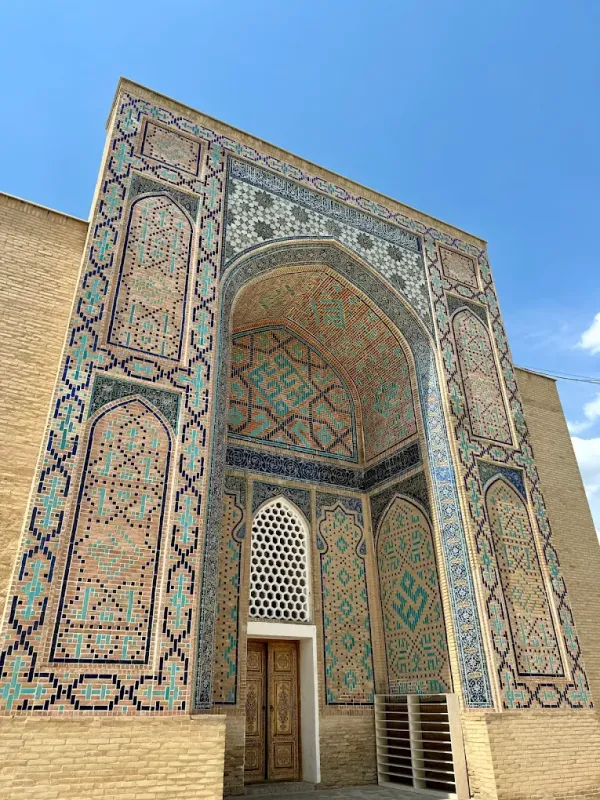
During the construction of this building, some elements of the layout were borrowed from the Sherdor Madrasah on Registan Square in Samarkand. The image of tigers on the portal, only without the sun, lined with mosaics, gave the madrasa its second name - "Sherdori berun" (i.e., "outer (country) Sherdor").
The monument has survived to our time in a badly destroyed form, its outer portal tilted one meter and threatened to fall, the roof and arches cracked, the cladding in the upper part of the entrance eastern portal disappeared during repairs in the early 20th century.In the 80s of the twentieth century, folk master Abdugaffor Hakkulov began restoration work in the madrasah, which continued during the years of independence.
To restore the appearance of the madrasah, many archival materials were studied, in particular, the work of the Samarkand scientist of the 19th century. Abutahir Khodji's "Samaria", as well as several photographs of the Nadir Divanbegi madrasah, taken back in 1870 and kept in the collections of the St. Petersburg Hermitage Museum. Among them was a photograph of the eastern entrance portal, on the tympanum of which fragments of a hunting scene with lions and deer are discernible. Also, according to Professor P. Zahidov, who found the monument not yet destroyed, "on the portal of this madrasah there were images of two lions and two deer, executed in the technique of carved mosaics."
Careful, painstaking study of archival documents, old black-and-white photographs of the last and penultimate centuries, and fragment modeling allowed restorers to completely restore the building and cladding of the Nadir Divanbegi Madrasah, which now stands before tourists and pilgrims in its original form.

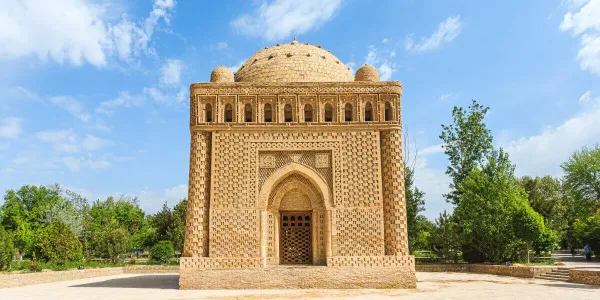
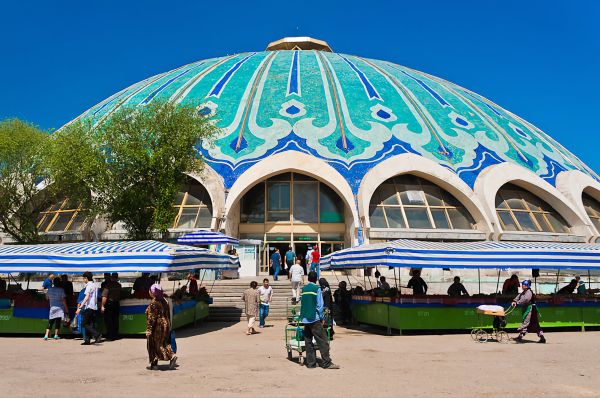



Place on the map
Tours where you can visit this place:
Juma Mosque Khoja Ahror Wali
Tashkent — Bukhara — Samarkand — Shakhrisabz
- 720$
- 7d.

Juma Mosque Khoja Ahror Wali
Tashkent — Bukhara — Samarkand
- 640$
- 7d.

Juma Mosque Khoja Ahror Wali
Tashkent — Bukhara — Samarkand — Khiva — Khorezm
- 730$
- 7d.
Juma Mosque Khoja Ahror Wali
Tashkent — Bukhara — Samarkand
- 500$
- 5d.

Juma Mosque Khoja Ahror Wali
Bukhara — Samarkand — Shakhrisabz
- 480$
- 5d.

Juma Mosque Khoja Ahror Wali
Bukhara — Samarkand — Khiva
- 440$
- 5d.
Juma Mosque Khoja Ahror Wali
Tashkent — Bukhara — Samarkand — Khiva
- 590$
- 6d.
Juma Mosque Khoja Ahror Wali
Tashkent — Bukhara — Samarkand — Shakhrisabz
- 1150$
- 7d.
