Rabat-i Malik Caravanserai
23 kilometers from Navoi, where caravans once passed, there are the remains of a once magnificent 11th-century palace, the Rabat-i Malik caravanserai, which means "Royal Fortress." Locals nicknamed the remaining portal the "Gates of Bukhara".
Rabat-i Malik was a fortified steppe residence of the Turkic rulers from the Karakhanid dynasty, who owned the lands of Transoxiana in the XI—XII centuries. From the 13th century, after the Mongol conquest of Central Asia, until the beginning of the 18th century, Rabat-i Malik served as a caravanserai for stopping trade caravans.
The residence included living rooms, a kitchen, a bathhouse, a mosque and stables. Not far from the gate was Sardoba, the main source of water supply, which has been preserved to this day. One of the sections of the Silk Road ran here.
Today, only the ruins of the caravanserai and the entrance portal can be seen here. The caravanserai was first mentioned in the middle of the 19th century. Its appearance was restored based on the drawings of travelers, as well as on the results of archaeological excavations of the last century, when 27-year-old naturalist A. Lehman made sketches of the monument.
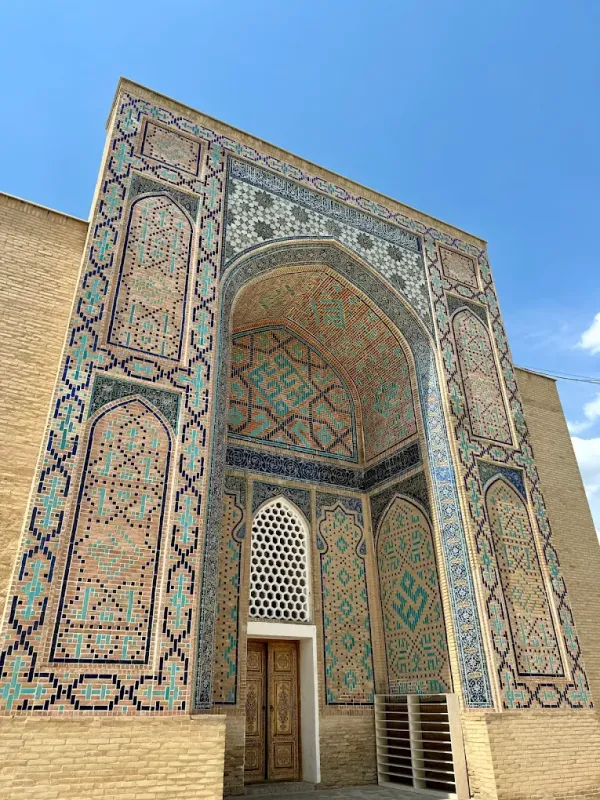
The caravanserai portal is lined with brick, forming a pattern of octagons and trefoils. The perimeter of the arch of the portal is decorated with a belt of epigraphy.